Home About Us Products Contact Link >>Japanese


The relationship among the spindle rotating speed, processing speed, and the tools

The rotation speed of the spindle motor should not necessarily
be high

One of the most frequently asked questions about spindle motors is their rotation speeds. It seems that many people believe that, "The higher the spindle motor's RPM is, the more accurately you can cut."

It is not incorrect to say that the higher spindle motor RPM enables precision cutting, however, neither is it correct to just look into RPM of the spindle motor. There are many factors you need to consider for precision milling.

One of the most important factors for precision milling is the behavior of tool tip while milling circuit boards, i.e., minimum level of vibration and runout.

No matter how high the spindle motor speed is, if the tip vibrates, the thin tools would brake and the cutting edges become rough resulting in poor RF characteristics.


Higher rotation speed of the spindle motor tends to cause the large degree of runout.
The below figure represents the correlation between the rotation speed of the small size spindle motor (Max speed 100,000 rpm) and its runout.

The Correlation between the rotation speed of the small size
spindle motor and its runout
Measuring instrument; MITS NANOMETRIC SENSOR MODEL 211


In this figure, degree of the runout sharply increases from the point over 75,000 rpm.
Additionally, when the degree of the runout augments, it ends up in many unfavorable results, such as

- Causing a lot of burrs on the circuits
- Thin end mills become even more fragile


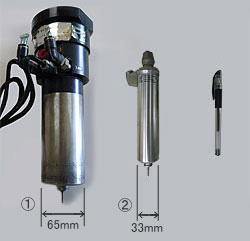
The picture shows a sample of a spindle motor used for a large mass production PCB milling machine and that of a desktop PCB prototyping machine. As you can see, the shape, size and price of these motors are quite different.

When we select spindle motors for our PCB prototyping machines, we evaluate them paying special attention to many factors such as the shape, weight, operability, rotation speed, and level of runout.
Our objective is to provide the customers with user friendly lightweight desktop PCB prototyping machines so that you can make prototype boards quickly without hassle in your company or institute.
This is why we are not pursuing higher RPM unnecessarily.


Most of commonly used spindle motors use ball bearings. However, with ball bearings, it is practically impossible to eliminate vibration or tool runout at higher rotation speed.
Desk top PCB milling machines use compact spindle motors. If you try to run them at higher RPM, the level of runout becomes too high to perform precision milling.


Some of the high performance spindle motors used on large PCB milling machines are capable of running at 100,000 RPM or higher. Their internal mechanisms, bearings, Collet Chuck mechanisms and others are specially designed and built so that runout at higher speed is minimal. Bearing mechanisms are especially important to minimize runout. Those high performance spindle motors use special bearings such as oil lubricated bearings and air bearings to control runout.


There is the optimum rotating speed for the tools

Tools have their own optimum speed of rotation and processing that the tool manufacturer recommends.

For instance, 90 degrees end mills, it is 30,000 rpm and 15mm/sec.
Higher rotating speed shortens the longevity of the tools and higher processing speed makes the tools fragile.

The optimum rotating speed and the optimum processing speed vary depending on the tools and the substrate board.
The finishes of the processing is better when the rotating speed is lower than higher depending on the processing material as reported by the case example by The University of Tokyo.


50µm(2mil) line and space, the state of the art!
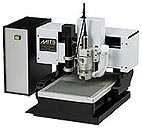
FP-21T Precision
Stepping method and non-contacting pressure foot lead to the fine processing technology


Fine Processing



MITS PCB prototyping machines are suitable not only for typical PCB prototyping but also for fine processing of various types of materials.


MITS General Catalog
English
(PDF file / 1.17MB)


MITS Electronics


5-1-9, Kajino-cho, Koganei-shi,
Tokyo 184-0002 JAPAN
TEL.+81 (0) 42 388 1051
FAX.+81 (0) 42 388 1060

E-MAIL

Contact us : Inquiry Form


MITS USA, Inc.

Masato Asai
E-mail :
Tel. +1 408-242-5364