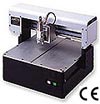
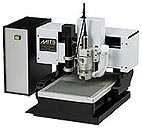
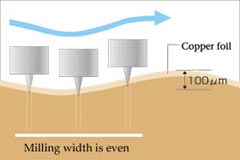
MITS' 3-axes-regulation machine can alternately perform the
two types of
milling operations, by simply switching between "incremental
milling" and
"absolute milling".
This is the MITS original technology.
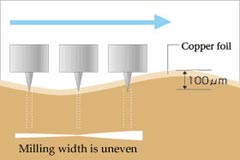
Absolute milling
You can numerically control the height (depth) of Z axis by
CPU.
Although the flatness of the table and the deflection of the
processed material
might influence the depth, it is effective in limited processing
on the not deflective
material in limited area.
Incremental milling
Detecting the surface of the board, and keeping the depth of
the milling bit on
the uneven surface makes the processing unaffected to the flatness
of the table.
Particularly it is advantageous when processing with the Pointed-end
milling bit
|
|
|
|
Absolute milling
|
Incremental milling
|